
The Science Café dates for 2026 are:
- Thursday 26th March
- Thursday 18th June
- Thursday 24th September
- Thursday 12th November, Science Festival Café
Thursday 26th March 2026, 7.30pm
This first Science Café of the year will follow our usual format – three expert speakers on diverse topics and time for Q&A after every presentation. On the menu this evening will be:
- Frontier Science – drones, Romans and river crossings at the edge of the Roman Empire
- Dr Kayt Armstong, Department of Archaeological & Forensic Sciences, University of Bradford
- How did the Romans cross the river Tweed? With the mobile laboratory she manages, Dr Kayt Armstrong and a team of intrepid archaeologists from Bradford are off to the edge of the Roman Empire to find out. As Kayt says, “February is a risky time for fieldwork but we should be ok!” Will their hunt for a bridge prove successful? Come to the Science Café to find out!
- You can find out more about this at https://www.bradford.ac.uk/news/archive/2026/bradford-led-project-to-explore-roman-empires-northern-edge-.php
- Dr Kayt Armstong, Department of Archaeological & Forensic Sciences, University of Bradford
- The Good, the Bad and the Leaky: growing blood vessels on-a-chip to model cancer drug delivery
- Georgina Lee, School of Physics & Astronomy, University of Leeds
- My talk will focus on how organ-on-chip is becoming an alternative to animal models, as well as the current drawbacks. I will also touch briefly on my research, which is specific to growing blood vessels.
- Georgina Lee, School of Physics & Astronomy, University of Leeds
- Weather Forecasting With AI
- Prof. Doug Parker, School of Earth & Environment, University of Leeds
- Over the past 3-4 years, AI-based weather prediction models have achieved the same levels of accuracy that “physics-based” models took 60 years to attain, using a fraction of the computational cost. We don’t know if this progress will continue, or whether all models have nearly reached a natural limit of prediction skill due to the mathematics of chaos.
- Although the rise of AI models has surprised many scientists, it can be viewed more simply as a return to ideas of statistical and analogue weather prediction, which had been largely abandoned in the 1970s as physics-based models advanced.
- Many claim that AI weather prediction will democratise weather prediction, but is it more likely to drive forecasting away from the public sector weather services and into the hands of global corporates?
- Prof. Doug Parker, School of Earth & Environment, University of Leeds
Further information and tickets:
The Science Café will start at 7.30pm on Thursday 26th March
As usual, tickets for the Café are £6, but free for students in full time education (though a ticket is still required)
Tickets are available from the Courthouse or you can click/tap here
Otley Courthouse Arts Centre
Courthouse Street
Otley
West Yorks
LS21 3AN
01943 467466
You can email Otley Science Festival here: info@otleysciencefestival.co.uk
or follow us on Bluesky, Threads or Facebook (we are no longer present on X / Twitter)
Earlier Cafés this year –
Tuesday 11th November
- Beyond the Notes: Exploring Pain and Suffering Through Spatial Acousmatic Music
- Prof. Mark Johnson, School of Health, Leeds Beckett University and Prof. Nikos Stavropoulos, Leeds School of Arts, Leeds Beckett University
- What happens when we start listening differently? This talk invites you to explore acousmatic music—where sound floats free from its source—and discover how it can unlock new ways of engaging with pain, emotion, memory, and suffering.
- Expect the unexpected.
- Prof. Mark Johnson, School of Health, Leeds Beckett University and Prof. Nikos Stavropoulos, Leeds School of Arts, Leeds Beckett University
- ‘The unseen problem of plant blindness‘
- Dr Julie Peacock, School of Geography, University of Leeds
- The phenomenon of plant blindness -“the inability to see or notice the plants in one’s own environment”, was first coined by Schussler Wandersee in 1998. There are evolutionary reasons why our brains developed to detect animals and not plants, which is exacerbated when coupled with an education system that does not value identification skills, and a general reduction in people’s connectedness to nature.
- This is problematic. If plants are unknown and undervalued, conservation effort is limited. Yet, plants are fundamental to environmental health and the survival of many animals, often viewed as worthy of protecting. An under-appreciation of plants also matters, ultimately, for human health. We cannot tackle many of the current global challenges without plant scientists and plant aware people.
- In this talk we will explore the issues and the impact of this phenomenon, and the role individuals can play in reversing it.
- Dr Julie Peacock, School of Geography, University of Leeds
- Concrete at War
- Mark Wrigley, Institute of Physics
- The physics behind Britain’s war time defences. From sound mirrors at Dungeness to systems of search lights and guns defending Scapa Flow, Britain’s coastline is dotted with abandoned wartime concrete structures. Once the home of thousands of service personnel they now rest deserted. The ‘Concrete at War’ project combines physics, photography and aesthetics to rediscover these structures
- Mark Wrigley, Institute of Physics
Thursday 11th September
- Can metals cure cancer?
- Dr Maria Azmanova, School of Pharmacy and Medical Sciences, University of Bradford
- When you think of metals, you probably imagine coins, jewellery, or maybe even something dangerous like lead. But what if some metals could actually save lives?
- In this talk, we’ll explore a surprising and powerful side of chemistry—how certain metals are being used to fight cancer. From the accidental discovery of platinum-based drugs like cisplatin (a breakthrough cancer treatment) to exciting new research into gold, ruthenium, and other lesser-known metals, you’ll hear how scientists are turning elements from the periodic table into life-saving medicines.
- We’ll look at real-world examples, the science behind how these “metallodrugs” work in the body, and how researchers are designing the next generation of treatments. No scientific background needed—just curiosity and a willingness to discover how metals might help us win the fight against cancer.
- Dr Maria Azmanova, School of Pharmacy and Medical Sciences, University of Bradford
- Bringing Soft Matter Physics to Life, how hard can it be?
- Professor Mike Ries, School of Physics & Astronomy, University of Leeds
- Soft Matter Physics is the physics of life itself. Learn how a flea jumps, why a rubber ball bounces, and how life is built on long chain molecules. Can a solid flow and a liquid shatter? Find out in this introduction to the physics of soft matter.
- Professor Mike Ries, School of Physics & Astronomy, University of Leeds
- The Octopus Will See You Now: How Softness Is Shaping the Future of Surgery
- Dr James Chandler, School of Electronic and Electrical Engineering, University of Leeds
- James specialises in Surgical Robotics with a research focus on the development of affordable, effective and safe soft robotic technologies for minimally invasive diagnosis and treatment of disease. He will be giving us an overview of some of current work at the STORM lab https://www.stormlabuk.com/
- Dr James Chandler, School of Electronic and Electrical Engineering, University of Leeds
Thursday 26th June
- The Weird World of Computational (Bio)Physics
- Dr Ben Hanson, Physics Education Research Group, University of Leeds
- You may have heard that physics is “the difficult one” of the fundamental sciences. Combining it with biology, computer science, and a sprinkling of philosophy, then, might sound impossible! In fact, this couldn’t be further from the truth. A well-rounded view of the scientific story is exactly what is needed to better our understanding of the world around us.
- In this session I will briefly introduce my field of interest, biological physics, where we’ll learn how physics can be used to assist biologists in understanding the most complex of systems: life itself. We’ll then look at how we can use modern technology to better showcase physics, by creating virtual reality representations of physical systems!
- Dr Ben Hanson, Physics Education Research Group, University of Leeds
- Trends in Air Quality in West Yorkshire
- Dr. Jim McQuaid, School of Earth and Environment, University of Leeds
- Whilst air quality in the UK continues to decline, new technological advances have meant that many cities now have several sites measuring air pollution, particularly particulate matter (PM2.5). In it’s State of Global Air report in 2024, the World Bank stated that “Air pollution accounted for 8.1 million deaths globally in 2021, becoming the second leading risk factor for death, including for children under five years”
- Even in the UK, it is thought annual mortality of human-made air pollution in the UK is roughly equivalent to between 28,000 and 36,000 deaths every year . In this talk I with present the Sensing Leeds network of PM2.5 measurements which is the largest deployment in the UK outside of London. The high spatial resolution means that it is possible to delve into the drivers of air pollution across the city. I will also demonstrate new visual tools including our new Air Quality Stripes which we can use to illustrate trends in air pollution.
- Dr. Jim McQuaid, School of Earth and Environment, University of Leeds
- Vital plumbing: What our blood vessels do for us
- Dr Kirsten Riches-Suman, School of Chemistry & Biosciences, University of Bradford
- Our blood vessels are amazing and quite literally keep us alive. They are far more than just simple tubes that take blood around our body, with an incredible diversity in how they function and behave not only between different people, but even within the same person. Come and join me for a whistle stop tour introducing the building blocks of the blood vessels. I’ll explain how they work, what can go wrong, and how I’m looking at improving the way that they function in both health and disease.
- Dr Kirsten Riches-Suman, School of Chemistry & Biosciences, University of Bradford
Thursday 27th March
- Radishes on Prozac
- Professor Laura Carter, School of Geography, University of Leeds
- Pharmaceuticals are essential for treating diseases and alleviating symptoms in humans and animals, but their impact extends beyond their intended use. Once administered, these chemicals can enter the environment, contaminating rivers, lakes, and soils where they may persist, posing risks to ecosystems and human health. We will explore how pharmaceuticals reach soils and are absorbed by plants, highlighting key pathways of entry and uptake. We will also examine the effects of pharmaceutical contaminants on plant growth and development, providing insights into their broader implications for agriculture, environmental sustainability, and public health.
- Good Things That Come in Small Packages
- Dr. Stephen Hickey, School of Chemistry and Biosciences, University of Bradford
- There are few scientific discoveries that result in the creation of whole new directions of scientific and technological endeavours, but the discovery of “Quantum Dots” has done just that. In this talk a brief history how nanomaterials have been used by our ancestors and the more recent discovery, development and applications of quantum dots will be described. Along the way an overview of what quantum confinement is and how it can arise will be introduced and a selection of materials where quantum confinement effects have been observed will be presented. Finally an overview of many of the present and potential applications, as well as some of the challenges, will be discussed.
- Back to the Moon
- Dr Sue Bowler, Editor of A & G, the magazine of the Royal Astronomical Society
- It’s not just NASA and ESA – everyone’s going to the Moon, or so it seems. What’s the attraction? And what are the challenges? Join Sue Bowler for a conversation about the latest global space race.
Here’s the info on our 2024 Cafés –
Wednesday 13th November
- Earth’s origin and the hunt for other habitable worlds
- Dr Catherine Walsh, School of Physics & Astronomy, University of Leeds
- In this talk Dr Catherine Walsh from the University of Leeds describe dthe processes that are thought to have happened during the birth and subsequent evolution of our solar system to create our life-friendly planet, planet Earth. She discussed the metrics of habitability that are used to search for life-friendly environments both within and outside of our solar system, including on the surfaces of planets orbiting other stars, the so-called, exoplanets. She described some of the state-of-the-art research, both current and planned, to search for potentially habitable exoplanets.
- Managing the Weight of Expectation
- Dr Helen Heaviside-Brown, School of Psychology, Leeds Trinity University
- The expectancies that people create about one other can have long lasting consequences for both the person who creates the expectancy and the person who the expectancy is created about. This talk reflected on the 2024 Olympic and Paralympic Games to explore the consequences of interpersonal expectancies within performance environments. It also outlined strategies for managing such expectancies. When doing this, Helen considered the transferable nature of these strategies within other performance settings (e.g., education, business).
- The Leeds Virtual Microscope (LVM)
- Professor Roy Ruddle, Leeds Institute for Data Analytics (LIDA), University of Leeds
- With digital pathology, doctors diagnose cancer from high-resolution scans of biopsies. Those scans are gigantic – typically 10 billion pixels. This talk described how the LVM was the first digital pathology software capable of running on ultra-high definition displays (8 – 50 megapixels), changed pathology practice in the Leeds Teaching Hospitals NHS Trust, was used to create new guidelines for the Royal College of Pathologists, and provided innovations that are having world-wide impact.
Thursday 19th September
- How can we use the heat beneath our feet?
- Prof. Dave Healy, Director of Geosolutions, School of Earth & Environment, University of Leeds
- In this talk, I’ll look at some of the existing geothermal energy schemes already in operation around the world, and then have a quick look at scope around Leeds and Yorkshire more generally. Lastly, I’ll consider what needs to change in the UK to ensure that we maximise the opportunity of clean energy from geothermal sources.
- Bottom-up diagnostics: an individualised approach to Autism
- Dr Tim Vestner, School of Psychology, Leeds Trinity University
- Our understanding and clinical practice of mental health are often tied up in abstract diagnostic categories. While this can be helpful, these categories come with a lot of assumptions and don’t always fit the person very well. Transdiagnostic approaches seek to work with the underlying processes and symptoms, rather than sticking to broad labels, like ‘Autism’. This talk will cover some of the ways in which cognitive research can help us move towards more individualised and pragmatic evaluations.
- Revolutionising your plate: Innovations in Food Structure
- Dr Paraskevi Paximada, School of Food Science and Nutrition, University of Leeds
- During this presentation we will explore how new technologies are changing the way we understand and manipulate texture, stability, and sensory attributes of food. From novel processing methods to plant based alternatives, we will discover how those innovation enhancing food quality, nutrition, and consumer satisfaction.
Thursday 20th June
- Achieving Precision Through Patterns
- Dr Sebastian Eterovic, School of Mathematics, University of Leeds
- Pure maths is meant to be a language that allows us to convey information with precision, but this can get tricky very quickly. One way that mathematicians have for sorting through complicated situations is to look for patterns. In this talk we will see a few natural examples and discuss the patterns involved (and sometimes, also the lack thereof).
- Transforming Healthcare With Artificial Intelligence
- Victoria Moglia, CDT for AI for Medical Diagnosis and Care, University of Leeds
- Artificial intelligence (AI) is promising to revolutionise the field of healthcare, offering unprecedented opportunities to enhance patient care and streamline medical processes. This talk will cover the applications of AI in healthcare, from early disease detection to robotic surgeries, as well as the ethical landscape surrounding these emerging technologies.
- What do climate projections beyond 2100 mean for adaptation?
- Dr Christopher Lyon, Leverhulme Centre for Anthropocene Biodiversity, University of York
- Most of our climate change projections stop at or before the year 2100. But the climate keeps changing after this arbitrary date. What might climate change look like for our children and grandchildren and beyond? How can we learn to live with a hotter Earth?
Thursday 14th March
- Insect Fertility in a Warming World
- Professor Amanda Bretman, Professor of Behavioural Ecology, University of Leeds
- As the world heats up, this affects many areas of biology. However, the thermal limits on reproduction has been much less studied than lethal thermal limits, yet reproductive limits better match natural species ranges. We are exploring the mechanisms that may make some species more sensitive to high temperature, along with differences between sexes in sensitivity and the interaction with life stage and ageing. This might help us to identify species of more conservation concern and perhaps develop mitigations.
- Life on the Shelf: Exploring Late Palaeolithic Landscapes Submerged at the End of the Last Glaciation
- Dr Simon Fitch, School of Archaeological and Forensic Sciences, University of Bradford
- Simon is leading the “Life on the Edge” project, using high resolution seismic data and novel sampling techniques to locate and map submerged Late Palaeolithic landscapes. The “Life on the Edge” project seeks to develop techniques and models, including the use of Parametric Echo Sounders and Autonomous Underwater Vehicles (AUV’s) to provide ground-breaking mapping of Late Palaeolithic coastlines. This will lead to the generation of models of Late Palaeolithic occupation that will identify archaeological areas of interest. This is significant since such data will assist government and developers in identifying areas of the seabed have most potential value for Late Palaeolithic preservation.
- Seeing Inside Viruses
- Dr Rebecca Chandler-Bostock, School of Molecular and Cellular Biology, University of Leeds
- TopicViruses carry a huge amount of genetic information; this allows them to replicate inside their host cells. During replication, viral genomes are packaged efficiently and specifically inside new viral particles. I use X-Ray Footprinting to piece together the structure of viral genomes inside infectious viruses. This gives us new insights into the infectious mechanisms of the viruses and may prove key in designing novel anti-viral drugs.
Looking back to 2023 Science Cafés
Thursday 16th November
- Textiles Under the Microscope
- Dr Phil Greaves, Principal, Microtex, Otley
- We are all familiar with day to day textile materials, from clothing under and outerwear, to carpets, towels and bedding, but how do the textiles we use end up as they are, and what can go wrong with them? Are consumers getting what they’ve paid for or having the wool pulled over their eyes?
- This talk will outlined some examples of textile investigations carried out using microscopy, and what was discovered about the items in question. You can find out more about this at http://www.microtex-analysis.com/
- Mapping carbon cutting cargo bikes
- Dr Ian Philips, Institute for Transport Studies, University of Leeds
- Dr Philips talked about ELEVATE, an ‘e-micromobility’ research project (e-bikes, e-cargo-bikes and e-scooters) led by researchers at Leeds, Brighton and Oxford Universities and funded by the Engineering and Physical Science Research Council.
- You can find out more about this at ELEVATE: E-micromobility in Leeds, Oxford and Brighton & Hove | The ELEVATE Project
- Chronic Pain Research at Leeds
- Dr Beatrice Bretherton-Liu, Leeds Teaching Hospitals NHS Trust
- The talk was on the management of long-term (chronic) pain, with the focus of research is on current and new therapies for helping individuals to manage their long-term pain.
- This includes a therapy called spinal cord stimulation. It involves sending electrical signals to the spinal cord to relieve pain and improve quality of life, sleep, physical function and many other aspects of everyday life. We are also interested in looking at how this therapy can change heart rate, blood pressure, breathing and nerve activity. These aspects may help with identifying individuals who may really benefit from this therapy.
- There is an active patient and public involvement and engagement group in the department. In the talk we shared how we have been involving patients and members of the public in our research, including co-producing research questions, funding applications and participant-facing study documentation
Thursday 14th September
- Pocket-sized satellites – making Space accessible
- Dr Viktor Doychinov, Bradford-Renduchintala Centre for Space AI, University of Bradford
- PocketQubes, as they are known, are satellites, or spacecraft, that are small enough to fit in a person’s pocket.
- In this talk we will explore why they were created, what they mean about our shared access to and use of space, and most importantly, what useful and exciting things we can do with them. We will talk about how we are developing one of these satellites at the University of Bradford.
- https://www.bradford.ac.uk/ei/research-and-business/bradford-renduchintala-centre/
- “Pop” Goes The Finger: A climber’s tale
- Dr Gareth Jones, School of Health, Leeds Beckett University
- The development of climbing as a competitive sport is reflected by its debut at the 2021 Summer Olympic Games in Tokyo, and inclusion in the Paris Games in 2024 and Los Angeles Games in 2028.
- The annular pulleys of the fingers are a vital yet commonly injured anatomical structure in climbing, such injuries were considered unique to the sport and familiarity with them is not widely known.
- Eyes on the Bog: Peatland Monitoring
- Beth Thomas, Yorkshire Peat Partnership (Led by Yorkshire Wildlife Trust)
- Yorkshire Peat Partnership has restored over half of the upland peat in the North of Yorkshire since 2009, blocking 2,632km of erosion grips and gullies and planting over 2.4 million plug plants.
- But how do we know this is working and improving our upland habitat? Research and Monitoring! Yorkshire Peat Partnership has recently begun a citizen science monitoring programme, Eyes on the Bog, this talk will be about what we are monitoring and why and how people have been getting involved in learning all about Yorkshire’s magical peatlands.
- https://www.yppartnership.org.uk/https://www.yppartnership.org.uk/
Thursday 22nd June
- Space elevator: science fiction to science fact
- Adrian Nixon – Board member of the International Space Elevator Consortium (ISEC) and Rob Whieldon – Director: Nixene Pub
- In this talk the speakers gave a brief history of space elevators, both fact and fiction, explained why rockets really don’t do the job and why a space elevator is the answer (the green road into space).
- They explored the science of a space elevator, how it works, the mechanics and engineering required, where is the best place to locate a space elevator and what happens next
- You can find additional information on the space elevator at International Space Elevator Consortium (ISEC) https://www.isec.org/
- Brain plasticity: how experiences shape our brains
- Dr Antonio Capozio, Faculty of Biological Sciences, University of Leeds
- The human brain has a remarkable capacity to adapt in response to external stimuli and to our experience, a mechanism known as “brain plasticity”. Thanks to recent technical advancements in neuroimaging techniques, scientists are now able to visualise how the brain changes its functions and morphology over time. In this talk, we will learn about taxi-drivers’ brains, what happens when you learn to play the piano and finally how scientists at the University of Leeds are employing brain plasticity to “stimulate” recovery of hand movements in people who suffered a spinal cord injury.
- Are we planting the wrong trees?
- Dr Robin Hayward (they/them), School of Earth and Environment, University of Leeds
- Every tree is different. They all fit slightly different niches in the environment and grow in slightly different ways. So how do you know if you’ve planted the right ones? Robin’s talk will cross continents to answer this question. From the newly planted ‘Gair Wood’ just outside Leeds to the logged and recovering rain forests of Southeast Asia, Robin will share their research on what makes a tree the ‘right’ tree to plant and where, sometimes, we might go wrong.
Friday 17th March
- Water, water everywhere, not any drop to drink
- Professor Iqbal Mujtaba, Dept. of Chemical Engineering, University of Bradford
- About 71 percent of the Earth’s surface is water but 97% of the planet’s water is salty and undrinkable. Currently the demand for freshwater is increasing by 64 billion cubic meters a year while the world’s population is growing by roughly 80 million each year and there is not enough freshwater. Water is, therefore, one of the global challenges and is everybody’s business. This talk will highlight social & technological perspective around water
- Should we give a monkey’s about pathogens?
- Dr Cassandra Raby, School of Biology, University of Leeds
- What do we share with monkeys? Genetics? Behaviour? What about diseases?
- Observing wild baboons has helped researchers to understand who we are and why we behave the way we do. However, in a time when emerging diseases pose a risk to both human health and ape conservation, can baboons also help us to understand these threats? Join me as I describe living with wild baboons to observe their friendships, health, and habits.
- Tidal forces on alien worlds
- Dr Adrian Barker, School of Mathematics, University of Leeds
- Since the detection of the first planet around another Sun-like star was first announced in 1995, astronomers have detected more than 5000 extrasolar planets. These have a diverse range of properties, and many are observed to orbit their stars much more closely than Mercury orbits our Sun. A particularly interesting class of planets are Hot Jupiters, which are as massive as Jupiter (the most massive planet in our solar system), but which orbit their stars very closely meaning they complete an orbit in less than 10 Earth days. At such short distances, gravitational tidal forces can affect the orbit of the planet and the rotation of the star. In this talk I will present the methods astronomers use to detect extrasolar planets, review some of their fascinating properties, and finally describe the role of tidal forces in determining the ultimate fates of close-in planets.
2022 Science Cafés
Wednesday 16th November (Science Festival Week)
- Why do we gain weight? – It’s all in your brain!
- Dr Gisela Helfer, School of Chemistry and Biosciences, University of Bradford
- No one wants to overeat, yet many of us are fighting a never-ending battle with our hormones and ancient, instinctive brain circuits to try to control our body weight – often unsuccessful. Join me on a journey through cutting-edge neuroscience research to explore why it is so difficult for many of us to lose weight, how the brain undermines our dieting efforts and why some people are hungrier than others.
- The buzz about bees
- Dr Liz Duncan, School of Biology, University of Leeds
- “Save the bees!” is a familiar phrase – but which bees? Liz will talk about her research on honeybees (and other bees), some of the threats to bees and what we can do to help.
- Cloudy with a chance it rained
- Dr Tamara Fletcher, School of Earth and Environment, University of Leeds
- Clouds are the greatest source of uncertainty in climate models. To test how climate models perform in future-like climates we test them on geologic warm periods, however, there is currently no way to reconstruct cloud in the distant past. Are our models getting cloud right? In this talk, I will take you through some of the ways we are trying to reconstruct that icon of the ephemeral, cloud, 4 million years in the past.
Thursday 15th September
- Radar aeroecology: spotting birds, bats and bugs with radar
- Dr Chris Hassall, School of Biology, University of Leeds
- Radar technology has revolutionised warfare and weather, but could it now unlock the secrets of global biodiversity declines? The talk will explain the gaps in current biodiversity monitoring that make it difficult to detect trends in the environment. We will then explore how radars – and especially weather radars – can provide novel insights into what is happening all around us in unprecedented detail.
- Making Science For All
- Lewis Morgan, Senior Lecturer, School of Teacher Education, Leeds Trinity University
- Lewis will describe and explain the term “Science Capital” and how we can all make science more accessible. Within the context of our educational system, the talk will briefly explore what can be done so that everyone gets the opportunity to be a scientist of tomorrow.
- Recycling A Star: From Ashes To Earth
- Dr Marie Van de Sande, School of Physics and Astronomy, University of Leeds
- We are all made of stardust. Most of the atoms in our bodies were forged in the cores of stars that died millions of years ago. As stars die, they expel their life’s work into space. They do this by either dramatically exploding as a supernova or via a gentle stellar outflow (the fate of our Sun). Besides atoms, the death throes of stars also produce dust particles. These flecks of soot and tiny sand grains are the building blocks of a new generation of stars and planets. By following the dust’s journey from a dying star into a new planet and studying its exotic chemistry along the way, we can try to understand the origins of life on Earth.
Thursday 16th June
- Endless possibilities
- Dr Katie Chicot, School of Mathematics & Statistics, The Open University and CEO MathsWorldUK
- Katie looks at different sizes of infinity and how we can measure them from the infinitely small to the uncountable.
- Tinnibot: Evidence base for a smartphone tinnitus companion app
- Dr James Jackson, Department of Psychology and Therapeutic Studies, Leeds Trinity University
- Our latest studies test the effectiveness of a new Internet Cognitive Behavioural Therapy (iCBT) smartphone application, designed to facilitate the daily management of tinnitus. For eight weeks, 85 participants were assigned to either a control condition, interaction with an iCBT application (Woebot); or engagement with a tinnitus-specific iCBT application (Tinnibot). Both applications saw significant reduction in self-reported anxiety levels when compared to controls. Furthermore, the tinnitus-specific app saw a clinically significant reduction in self-reported tinnitus distress at the eight week end point. Future implications of using smartphone applications for tinnitus are discussed.
- Here are some related links:
- Senior Lecturer designs app to support people with tinnitus – 2020 – Archive – News – Leeds Trinity University
- Hearing Power | Say hello to Tinnibot, your tinnitus companion
- About Us · Hearing Power
- Smashing ions for efficient computing
- Dr Philippa Shepley,School of Physics and Astronomy, University of Leeds
- As we use more and more power to run all of the cloud storage and computing we do every day, we need new solutions to make computers more energy efficient. I will explain how we use nanoscale engineering of materials for energy efficient computing. With a demo I’ll show how we modify the properties of materials by implanting a few atoms of one metal into another. The idea is that having this atomic precision allows us to fine-tune how the materials behave in devices like computer memory.
Thursday 24th March
- Solar Windy with a Chance of Geomagnetic Storms: a long-term forecast for UK space weather
- Dr Jon Mound, School of Earth and Environment, University of Leeds
- In addition to light, the Sun constantly gives off a stream of charged particles called the solar wind. The strength and speed of the solar wind varies through time and is particularly strong after coronal mass ejections – massive eruptions on the surface of the sun that throw solar wind particles out into space at hundreds of kilometres per hour. When the solar wind reaches Earth, in interacts with the planetary magnetic field and cause a variety of effects referred to as space weather. Space weather events can disrupt satellite functions, damage transformers on high power electrical transmission lines, and light up the night skies with spectacular aurora. In this talk, I will cover some of the work that our team at Leeds has been involved with, trying to evaluate how much of a risk Space Weather poses to the UK, both at present and over the next 50-100 years.
- The Technology of Architecture
- Dr Matthew Brooke-Peat, School of Built Environment, Engineering and Computing, Leeds Beckett University
- Architectural Technology is rooted in science and engineering knowledge applied to the design of sustainable and inclusive buildings. This creative discipline forms the link between concept and realisation by designing for production (how buildings are constructed) and performance in use (how buildings work). Architectural Technology focuses on the development of responsible high performance practical solutions that respond to architectural need through the implementation of digital and physical technologies. This talk will provide an illustrated overview of the Architectural Technology discipline and the work of the Chartered Architectural Technologist.
- Smart materials to keep antibiotics working; stopping the post-antibiotic era
- Professor Stephen Rimmer, School of Chemistry, University of Bradford
- We don’t have an overview but you can find information about Professor Rimmer’s research group at http://polybiomaterials.com
2021 Science Cafés
Tuesday 16th November, 7.30pm – Science Festival Week Café
- Dung and Dusted: Was sheep’s dung used to fire pots in prehistoric Europe?
- Dr Mike Copper and Dr Gregg Griffin, School of Archaeological and Forensic Sciences, University of Bradford
- Despite their enormous importance to archaeologists, surprisingly little is known about how pots were fired in prehistoric Europe before the introduction of kiln technology. While ethnographic studies can present us with various possibilities and help us to generate testable hypotheses, experimental archaeology also provides an important method for investigating past technological practices. This talk will present the results of the experimental project Dung and Dusted, recently undertaken at the University of Bradford, that aimed to evaluate the possibility that sheep dung was used to fire pots during the Neolithic and Bronze Age and to identify ways in which the use of dung can be distinguished from other fuels in archaeological contexts. A hot topic you will surely want to get to the bottom of!
- Fantastic fibre optics! Next-generation seismic monitoring in a Greenlandic Glacier
- Dr Adam Booth, School of Earth and Environment, University of Leeds
- Understanding the flow dynamics of ice is essential for predicting their evolution in a warming climate. Geophysicists have used seismic surveys for many years, to monitor the internal structure and basal conditions of glaciers, but interpreting the required detail from the seismic data remains challenging. Novel fibre-optic technologies offer enormous potential for overcoming this hurdle – and my final pre-covid field campaign was a demonstration of the fibre-optic future of seismic surveying on Greenland’s Store Glacier.
- Putting the A in STEM
- Dr Briony Thomas, School of Mechanical Engineering / School of Design, University of Leeds and Chair of Leeds Cultural Education Partnership
- Science communication has never been more essential. Despite this, a study by the British Science Association (2020) revealed that almost 9 in 10 young people felt that scientists and politicians were leaving them out of the COVID-19 conversation. In this talk, I will share an approach to ensure that the voices and concerns of young people living in Batley were heard. The project used visual arts and design – a STEAM approach – to explore the science behind the coronavirus pandemic and engaged young people in creative activities that were shared with their community.
- You can find out more about the Leeds Cultural Education Partnership here
Thursday 16th September, 7.30pm – the “back to normal” Science Café
After our socially distanced in-the-room (and on Zoom) June Science Café in September we returned to our normal format, sitting around tables in Otley Courthouse.
Our three talks on this evening covered:
- Covid-19 vaccines – access, equality and success
- Dr Liz Breen, Director of the Digital Health Enterprise Zone, University of Bradford
- The advent of the Coronavirus pandemic in late 2019 created pandemonium throughout the world, challenging every aspect of our society. Overnight we became experts in vaccine production and logistics and engaged more with our NHS as a matter of urgency. Access to vaccines locally and globally became the ultimate priority, one that seemed to be very difficult to achieve in a transparent and sustainable manner. We invested huge levels of hope in our vaccines working as our way out of the pandemic and to reduce the pressure on our NHS. The Digital Health Enterprise Zone at the University of Bradford hosted the Novavax vaccine trial and currently supports the Covid-19 vaccine booster trial. My personal interest in this vaccine supply chain has led to the delivery of multiple articles with global coverage and associated media engagement. I invite you to join a discussion on vaccine access/equality and the success of our Covid-19 vaccination programme.
- Pachyderms, parrots and Polynesian tree snails
- Dr Mark Stidworthy, Principal Veterinary Pathologist, International Zoo Veterinary Group
- We know autopsies help solve human murder mysteries and surgical biopsies guide our medical treatment, but what can veterinary pathologists teach us about zoo animals and wildlife? Illustrated with examples from my work I will show how comparative pathology (from invertebrates to elephants) can control disease outbreaks and support conservation programmes, even keeping human populations healthy.
- Why BUY? The science behind consumer behaviour
- Dr Alessandro Biraglia, Leeds University Business School
- No matter how much or how little, how consciously or not, we all consume goods in our daily lives. But why do we buy what we buy? Using examples from recent research (bothmy own and others), in this talk I will embark on a short journey looking at what individual factors and environmental drives lead to consumption development and evolution.
Thursday 17th June, 7.30pm – the “back in the room” Science Café
We remained optimistic and it happened. We welcomed people back into Otley Courthouse for this Science Café for the first time since March last 2020. We also provided the facility to join on-line, our first “blended” event. We had the speakers and socially distanced audience in the Courthouse and shared the presentations on Zoom, not without some challenges! But we got there (mostly).
Our topics on the evening were:
- Weaving with DNA
- Dr Andrew J. Lee, Centre Manager, Bragg Centre for Materials Research, University of Leeds
- We have all heard of DNA, but how much do you really know about it? No doubt you have learnt that DNA holds the instructions for life, used to make everything from a lemon to a lion. But can you use it to make shapes, robots or even archive every meme on the internet? In this talk I will re-introduce you to DNA, the material, and explore how we can repurpose its chemical properties to create tiny self-assembling machines. Forget Biology, this is DNA nanotechnology!
- Drawing to Remember – beyond Encoding?
- Janet Love, Committee Member, Otley Science Festival
- Drawing is a powerful tool and is particularly associated with Art Therapy. Beyond this, the power of drawing is increasingly being investigated in other fields of psychology including stroke recovery, eye-witness testimony and especially education. However, there is a gap investigating drawings potential to actively and accurately retrieve object names whilst drawing alone….Janet Love presents tentative results of such an investigation conducted during her MSc in Cognitive Development and Disorders at the University of Leeds, 2019-2020.
- Wastewater in the Wharfe
- Professor Rick Battarbee FRS, Environmental Change Research Centre, University College London
- Following concerns about the frequency of untreated sewage spills into the River Wharfe from the Ashlands Sewage Treatment Works in Ilkley the Ilkley Clean River Group was formed. Its campaign to clean up the river has helped to raise awareness about the health hazards faced by wild swimmers and other recreational users of rivers throughout the country. This talk explains how citizen science was used, and is being used, to underpin the campaign on the Wharfe.
Thursday 18th March – our first Science Café of 2021
It seems we called this one correctly as we made an early decision that this would be an on-line only event.
However was an excellent evening with, as ever, a great line up of three speakers, with the chance to hear from and then fire questions at top scientists from around the region* as they set out to encapsulate a key idea in just 10-15 min.
(* you may spot our wide definition of “region”: we were delighted to have one speaker who would normally be well beyond the borders of Yorkshire, but in these strange times…)
- What has the LHC ever done for us?
- Dr. Duncan Leggat, Institute of High Energy Physics, Beijing
- The Large Hadron Collider (LHC) at the CERN facility in Geneva, Switzerland has been smashing atoms together for more than a decade now, and has made countless measurements including the discovery of the Higgs Boson, for which Peter Higgs and Francois Englert were awarded the Nobel Prize for Physics in 2013. But what does this mean for our everyday lives? Far beyond the scope of carrying out research ‘just for research’s sake’, the technology and methodology developed at CERN and for the LHC have had a marked impact in wider society. This talk will explore just exactly what ‘the LHC ever did for us’.
- You are never alone – the hidden living world inside you
- Prof. Philip Quirke, Professor of Pathology, School of Medicine, University of Leeds
- Phil will change the way you look at yourself. He will describe the intimate and important relationship you have with the life forms that live with/in you and how we are starting to understand the complex interactions that exist and how they contribute to health and disease with a particular emphasis on bowel cancer.
- Science with a telescope ten miles across
- Dr. Katherine Johnston, Research Fellow, School of Physics and Astronomy, University of Leeds
- How do astronomers use telescopes many miles across to observe at wavelengths much longer than our eyes can see? And what do they uncover? I will introduce a “telescope” just like this: the Atacama Large Millimeter/submillimeter Array (ALMA), and give you a glimpse of what I have discovered using this cutting-edge observatory.
And so back to that year…
2020 Festival Week Science Café – Tuesday 10th November
Following announcement of the new lockdown the 2020 Science Festival Week Science Café went ahead as an on-line only event.
- A brief history of biopharmaceutical – scientific drivers for adoption of large molecule therapeutics
- Siân Estdale BSc, MPhil, PhD, Head of Scientific Affairs, CTTS, Covance Laboratories Limited
- This presentation will look briefly at the historical context for large molecules, the current market of approved large molecules, modalities and therapeutic targets. It will explore the mechanism of action of some block buster molecules and compare with small molecules. The major differences will be highlighted and finally the drug development pathway and probability of success.
- Ecological risk assessment for biopesticides
- Dr Mark Whittaker, Managing Director, Applied Insect Science Ltd
- Biopesticides are low-risk crop protection products based predominantly on naturally-occurring bacteria, viruses and fungi. They are approved for use in Europe under the same regulatory framework as conventional pesticides, for which the assessment of environmental safety is one of the most significant aspects of the evaluation. This presentation will outline the use and benefits of microbial biopesticides in commercial horticulture, and the role of safety testing on pollinators and other non-target organisms.
- Bragg Centre Creative Labs: Innovation through collaboration
- Professor Lorna Dougan, Professor of Physics, Director of Research & Innovation, EPSRC Fellow
- In 2019 and 2020 ten teams of artists and creative professionals were paired with Bragg Centre for Materials Research members to explore collaborations and create ideas together. With no expectation of an output, the process allowed partners to establish the focus of their engagement with each other from the outset. In this talk I will share our motivation for undertaking this endeavour, what we learned along the way and next steps.
September 2020’s Science Café went virtual
We didn’t manage to go ahead with a Science Café in June but for September we decided to go ahead and have an on-line only event. We had two great speakers and this was what was covered on the night:
- Education for the 4th Industrial Revolution (e4i4)
- Professor John Baruch, Visiting Professor Leeds Beckett University, Tsinghua University
- The 4th Industrial Revolution will replace about 50% of UK jobs with robots using AI control systems either for talking to people and answering questions or for driving vehicles and everything in between. Close human support tasks are impossible to robotise such as nursing or teaching but many others will go. The cost of goods will continue to fall but the key challenge is developing the new economy with its new jobs and new types of work based on technological innovation and creativity. The talk will focus on how the under 28 year olds can rebuild their lives, and opportunities exploiting the unique situation they now find themselves in with the Tsunami of Covid 19.
- Baby Talk – How connection in infancy supports connection throughout life
- Dr Vivien Sabel, Senior Lecturer at Leeds Beckett University
- Psychotherapist, Author, Lecturer, Filmmaker and Artist, Dr Sabel is attending the Science Café to share her learning regarding how understanding the language of infants has supported the development of a non-verbal communication model for use in clinical and everyday settings. Her ‘back story’ and educational journey are key to understanding the development of the model and have proved fascinating to audiences in both nationally and internationally.
2020’s first Science Café was on Thursday 12th March
Before everything closed down our topics for that evening were:
- Not just dinosaurs: the prehistoric British Isles
- James McKay, School of Chemical & Process Engineering, University of Leeds
- You can find out more about scientist and illustrator James at https://www.cusp.ac.uk/about/fellowship/j_mckay/
- He will be bringing copies of his book “Trilobites, Dinosaurs and Mammoths An Introduction to the Prehistory of the British Isles” which you can purchase and have signed, if you wish. You can find out more about it here: https://www.nhbs.com/trilobites-dinosaurs-and-mammoths-book
- Science with a telescope ten miles across
- Dr Katharine G. Johnston, School of Physics & Astronomy, University of Leeds
- You can find out more about Katherine at https://eps.leeds.ac.uk/physics/staff/4441/dr-katharine-g-johnston
- Artificial neural networks: what, why and how?
- Dr Jamie Owen, Lead Trainer, Jumping Rivers Ltd.
- Find out about Jumping Rivers at https://www.jumpingrivers.com/about/
2019 Festival week Science Café was on Wednesday 13th
On this enjoyable evening we covered:
- A civic plan for a climate emergency
- Professor Paul Chatterton, School of Geography, University of Leeds
- The climate emergency is a huge threat, but also a huge opportunity. Many people feel powerless in the face of huge global changes out of our control. At my talk I will be discussing how we can organise and take meaningful action to create liveable affordable, green and climate safe neighbourhoods. I’ll be talking about car free cities, biophilia, blue green infrastructure, community led housing, civic energy, and how we can build common wealth. This is a huge opportunity to change our places for the better. We have to think big, start small and act now.
- Paul is the author of “Unlocking Sustainable Cities” http://unlockingsustainablecities.org/
- My memory and me – the importance of remembering our own life
- Dr Jelena Havelka, School of Psychology, University of Leeds
- Jelena investigates the impact of life changes and transitions on our sense of self and how major public events play a role in organising autobiographical memory.
- The Analogue Moon
- Mr Mark Wrigley, Chair of the Yorkshire Branch of the Institute of Physics
- Mark’s interest in science and technology stemmed from watching the first moon landing live on television as a schoolboy. He filmed the screen with a Super 8 camera, in the days before domestic TV recording technology existed, and his footage of the 1969 event forms part of a display at the Science and Media Museum.
- A session in commemoration of the 50th anniversary of the moon landing and in anticipation of tomorrow night’s film, Apollo 11
The September 2019 café was on Thursday 26th
The topics for this café were:
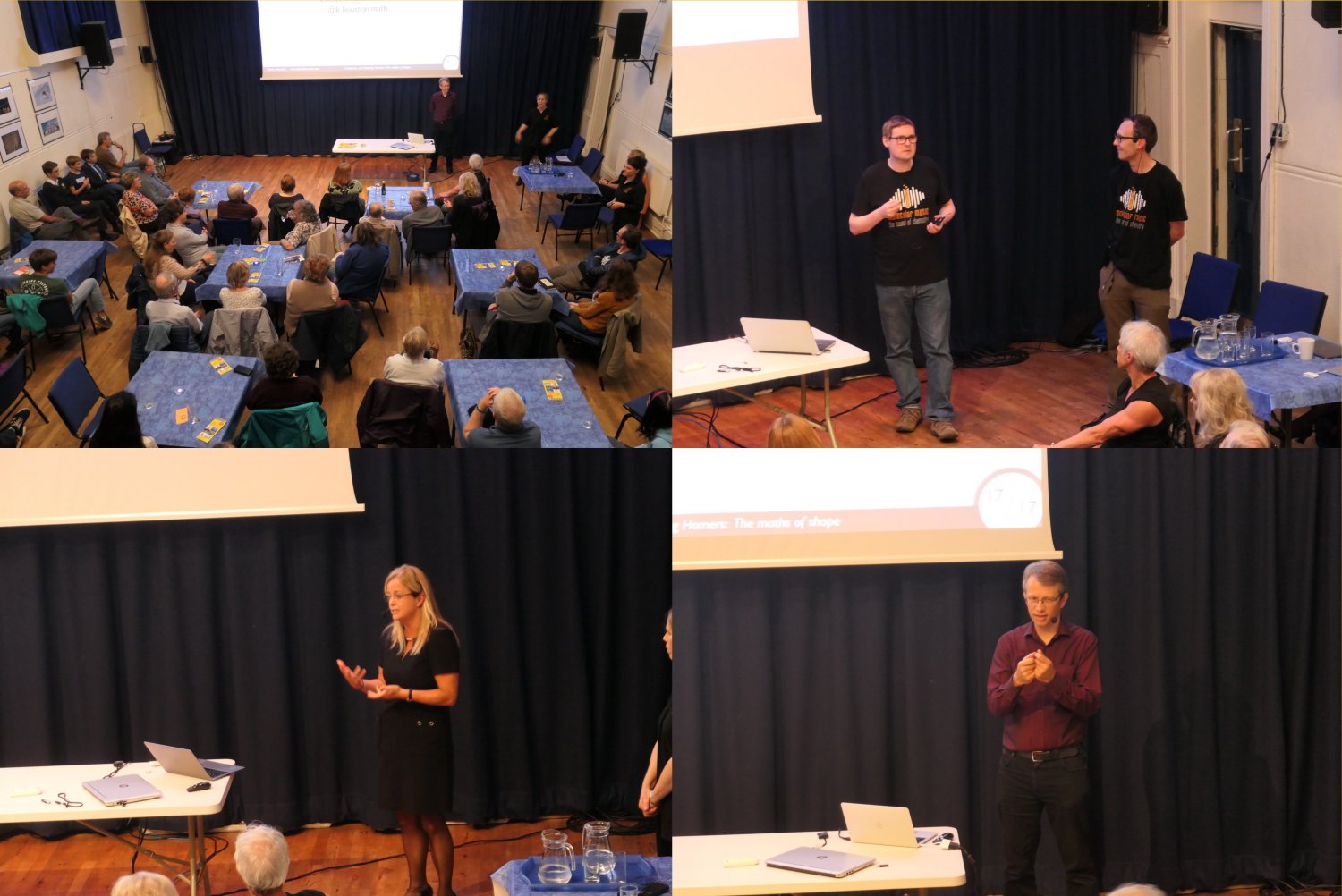
- Molecular music: the sound of chemistry
- Dr Nicolas Barry & Dr William Martin, School of Chemistry & Biosciences, University of Bradford
- They will talk about the “amazing” week they had at the Royal Society summer exhibition presenting their project with Ilkley Grammar https://royalsociety.org/grants-schemes-awards/grants/partnership-grants/the-sound-of-chemistry/
- Sugar, fat, alcohol… what’s worse for the liver?
- Dr J. Bernadette Moore, School of Food Science & Nutrition, University of Leeds
- She will be presenting her recent research on sugar versus fat in non-alcoholic Fatty Liver Disease pathogenesis
- Caricatures and Dancing Homers: The maths of shape
- Dr Kevin Houston, School of Mathematics, University of Leeds
- Discussing using mathematics to animate shapes to move in time with music. You may have seen Kevin at the Bradford Science Festival on a stall representing MathsWorldUK (dedicated to establishing the first maths museum in the country)
The June 2019 Science Café was held on Thursday 13th
That night the discussions covered:
- What can dirty teeth tell us about the past
- Dr Anita Radini, Department of Archaeology, University of York
- Drowning: how science can help us avoid it.
- Dr Martin Barwood, School of Social and Health Sciences, Leeds Trinity University
- Blockchain – What’s all the fuss about?
- Andy Thomas, CTO, Aprexo Ltd and Codel Ltd
The first Science Café of 2019 was on March 14th
On that evening the sessions covered:
- Phage Display: why the Nobel prize went viral
- Dr Christina Rauber, Senior Scientist, Avacta Life Sciences
- Jumpers for goalposts or is there more to football science?”
- Prof. Mark Russell, School of Social and Health Sciences, Leeds Trinity University
- Decontaminating my grandfather’s chemical legacy
- Prof. Mark Lorch, School of Mathematics and Physical Sciences, University of Hull
- This was a surprising, interesting and entertaining tale of a (literally) dangerous family legacy. If you’d like to read it or share it with friends, you can find it on line here
Earlier Science Cafés
For the record we have also left available information about our Science Cafés from 2017 and 2018. This can be found here.
September ’17 Café follow up: local air pollution
Professor Pilling C.B.E. (Emeritus Professor, School of Chemistry, Univ. of Leeds) provided the following links related to local air quality issues for us to share here.
- Link to the Defra Air quality monitoring network: https://uk-air.defra.gov.uk/networks/ . You can find data for a wide range of pollutants, including NO2 and PM2.5. Look especially at the two sites in Leeds
- Leeds City Council 2018 Air Quality Annual Status report: https://www.leeds.gov.uk/docs/Air%20Quality%20Annual%20Status%20Report%202018.pdf. The Council is required by government to produce a report on Air Quality Management Areas AQMAs. The article gives a review of the 48 measures it has and is undertaking and also gives information on the AQMA in Pool.
- Clean Air Leeds: http://www.leeds.gov.uk/Business/Pages/Air-quality.aspx
- UK plan for tackling roadside nitrogen dioxide concentrations (July 2017)
https://www.gov.uk/government/publications/air-quality-plan-for-nitrogen-dioxide-no2-in-uk-2017 This is the Governments plan to reduce NO2 concentrations. There are several reports – the summary gives a good feel for the overall strategy
 Otley Science Festival